
The intriguing bit is that Trump is likely to attend the talks in Islamabad this weekend -- if he does, it will be the clearest signal yet that the US is ready to exit the war with some sort of win to show, since he cannot afford to go for the talks and return empty-handed, notes Prem Panicker in his must read blog on the Iran War

If TVK MLAs and ministers are perceived as clean, or demonstrably cleaner than their predecessors, the credibility dividend will be enormous. The voter will feel rewarded, points out Ramesh Menon.

The 'rescue' operation occurred within kilometres of Iran's underground tunnel complex at Isfahan, assessed by the IAEA and US intelligence as holding a substantial portion of the country's 60 per cent enriched uranium stockpile. Retired senior US military officers have highlighted that the mission's footprint -- hundreds of special operators, multiple heavy-lift aircraft deep inside Iran -- appears outsized for recovering a single airman. Prem Panicker continues his must read blog on the Iran War.

The rupee recovered 55 paise from its all-time low level to close at 90.38 against the US dollar after a volatile trade on Wednesday, amid suspected aggressive central bank intervention.

...is a way out, notes Prem Panicker in his must read blog on the Iran War. What the indefinite extension produces is a prolonged condition of not-war-not-peace, in which oil markets cannot stabilise, Asian refineries cannot plan, European governments cannot stop subsidising consumption they cannot afford, and the next flashpoint -- a seized tanker, a miscalculated drone strike, a Truth Social post that claims too much -- is one news cycle away.

Among Sensex firms, Bajaj Finserv, Bajaj Finance, Tata Steel, Reliance Industries, Sun Pharma, Tata Motors Passenger Vehicles, Axis Bank and Infosys were among the major gainers. Bharti Airtel and Asian Paints emerged as the laggards from the pack.

'Crude oil prices are around $66-67 per barrel now but could fall to $55-60 if global disturbances ease.'
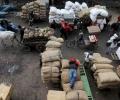
Notwithstanding global headwinds, the Indian economy saw further momentum in October on the back of goods and services tax (GST) rate rationalisation and festival spending, as indicated by high-frequency indicators, the Reserve Bank of India's (RBI's) monthly State of the Economy report said.

Gold prices came under renewed selling pressure in the pre-New York opening hours on Wednesday morning, this time responding to a declining crude oil and rising US dollar value. Values quickly fell towards the lower $900's as participants continued to be frustrated by the metal's recent lack of response to outside drivers and by investor apathy. The current pause is still seen as a period of consolidation and the risk of a breach of the $900 level remains in place.

Gold imports climbed 349.22 per cent to $12.07 billion in January, while silver imports rose 127 per cent to $2 billion.

India's net oil import bill could widen to $101-104 billion in current fiscal from $96.1 billion in 2023-24 and any escalation in the Iran-Israel conflict could impart an upward pressure on the value of imports, ICRA said on Tuesday. The domestic rating agency said based on its analysis, lower value of Russian oil imports is estimated to have led to savings of $7.9 billion in 11 months (April-February) of 2023-24, up from $5.1 billion in 2022-23.
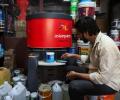
Asian Paints reported a good performance for the second quarter (July-September) of 2025-26 (Q2FY26), with some help from base effects, despite strong competition and extended monsoon. Volume grew in low double digits in the key domestic decorative paints, and value in that segment grew by 6 per cent. Ebitda (earnings before interest, taxes, depreciation, and amortisation) grew 21 per cent year-on-year (Y-o-Y), and PAT (profit after tax) grew 14 per cent. Asian Paints also defended market share better after several quarters where it had lost ground to Birla Opus.

State-owned fuel retailers are losing close to Rs 3 per litre on selling diesel while the profit on petrol has trimmed due to recent firming up in international oil prices, industry officials said detailing reasons for continuing to hold retail prices. Indian Oil Corporation (IOC), Bharat Petroleum Corporation Ltd (BPCL) and Hindustan Petroleum Corporation Ltd (HPCL), who control roughly 90 per cent of India's fuel market, 'voluntarily' have not changed petrol, diesel and cooking gas (LPG) prices for almost two years now, resulting in losses when input cost was higher and profits when raw material prices were lower.
The wide-ranging sanctions imposed by the US on the Russian oil sector have started to dent near-term oil flows to India with state-owned Bharat Petroleum Corporation Ltd (BPCL) saying not enough cargoes are available for March.

Cooking gas or Liquified Petroleum Gas (LPG) price has been raised by Rs 50 per cylinder by distribution companies, Union Oil Minister Hardeep Singh Puri said on Monday.
Oil Minister Murli Deora has said that petrol and diesel prices would not be cut till crude oil prices fell to $67 a barrel, since the depreciation in the rupee against the US dollar had eroded gains from falling oil prices, which touched a 7-month low.

Fight on toward goals that keep receding, or exit with most objectives unmet. Trump is agitated, his poll numbers falling below the Plimsoll line, his base fractured between those who back the war and those who remember that he campaigned on ending them.

The delegations from the US and Iran head to Islamabad on Friday, carrying a ceasefire that is already fraying, a Strait that is technically open and practically closed, and a negotiating agenda that would challenge even parties actually negotiating in good faith, which these groups are not. Prem Panicker continues his must read blog on the Iran War.

Among Sensex firms, Bharat Electronics, Eternal, Mahindra & Mahindra, Kotak Mahindra Bank, Tata Motors and Power Grid were the gainers. However, Adani Ports, ITC, UltraTech Cement and Titan were among the laggards.

The Indian rupee, swaying through multiple headwinds, tiding over global trade disruptions and massive foreign fund outlfows, is unlikely to arrest its descent until tariff impact overhangs, notwithstanding robust domestic macroeconomic tailwinds. The Reserve Bank of India (RBI), which sees the rupee's depreciation as a silver bullet to offset the tariff shock, expects the currency to find its stable course once India reaches a trade deal with its largest trading partner, the US.

Usually, a fall in oil prices is followed with a cut in retail prices of auto fuels and the government passes on the benefit to consumers. However, Morgan Stanley believes gains this time around will remain capped.

The pause gives the US time to breathe, to regroup, to move its expeditionary force into position without risk of interception along the way. It gives Iran nothing -- on the ground, attacks against its infrastructure continue apace. Prem Panicker in his must read daily blog on the Gulf War.

The companies' underrecoveries stood at a whopping Rs 1,39,869 crore last financial year. Of that, Rs 62,837 crore was accounted for by diesel alone.
Last week's fuel price cut will impact margins of oil companies such as Indian Oil Corporation less severely than it did when prices were last reduced in February 2007, giving the government room for another round of price cuts on automobile fuels before general elections early next year.

Essar Oil has cut petrol and diesel prices by an average of Rs 1.50 a litre to bring them at par with that of public sector firms.

'If the US stagnates and falls into a recession, the dollar will weaken, oil prices will also dip. This augurs well for India.'

'The next two to three weeks will not be decided in Washington.' 'They will be decided in Tehran, in whatever calculation Iran makes about the costs of continued resistance against the costs of appearing to have yielded.'

The fiscal tilt towards capex benefits companies in investment-related sectors like capital goods, defence equipment, engineering & construction and metal & mining. The planned cut in revenue expenditure will weigh on companies in consumption sectors like FMCG, consumer durables and retail.

Global trends, macroeconomic announcements and US tariff developments are expected to drive stock markets in a holiday-shortened week, analysts said. Market participants will also closely track foreign investor activity, geopolitical tensions, and their impact on the US dollar and crude oil prices, they added.

Packaged food major Nestle India posted better than expected September quarter results led by strong volume growth across its key segments. While there were margin pressures due to elevated raw material costs, there could be some relief with easing prices in the near term.
International crude oil prices have fallen over 33 per cent from their recent record highs and are projected to fall further towards $90 per barrel with the second hurricane in the Gulf of Mexico not causing as much loss of production as was initially estimated.

Dubai's core promise -- that it is an oasis untouched by regional storms -- has been tested in full public view. The coming months will show whether investors view the attacks as a short-lived disruption or a deeper signal of lasting risk, points out Asif Ullah Khan.
If crude oil prices stay at current levels, the Indian government would not be required to issue additional oil bonds to the four state-run oil marketing companies in the current financial year, Finance Minister P Chidambaram said on Monday. Oil retailers, however, are unlikely to cut prices of petroleum products in response to falling crude prices unless private retailers like Essar Oil and Reliance Industries Ltd restart operations and offer a lower price.
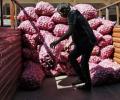
Wholesale prices fall 2.06% in February.

For weeks, the war skirted the edge of catastrophe without tipping over. Missiles flew, there was much destruction, commanders were assassinated, cities across the Gulf and even in Israel struggled to absorb the shock. But one line held: Energy infrastructure, the arteries of the global economy, remained largely untouched. That is no longer true. Prem Panicker continues his must read daily blog on the Gulf War.

The best way for India to prepare is by preserving and strengthening the RBI's hard-won credibility, point out Rajeswari Sengupta and Vaishali Garga.
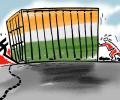
Merchandise exports to the US jumped 23.5 per cent year-on-year (Y-o-Y) to $8.3 billion in June, even as India's overall outbound shipments witnessed contraction during the month, according to the data released by the commerce department on Tuesday. The increase in outbound shipments to the US was largely driven by the rush among exporters to utilise America's pause on its plans to impose country-specific reciprocal tariffs.

'The impact of COVID-19 on the economy has been so overwhelming that even a significant drop in global oil prices, which in normal times would have brought cheer, has posed new challenges for the government,' observes A K Bhattacharya.
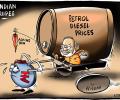
The oil sector has been quite lucky for the Modi government. It has often provided an opportunity to the government to mend its finances, notes A K Bhattacharya.

Reliance Industries Ltd (RIL) on Friday reported a 9.6 per cent year-on-year rise in net profit for the September quarter, driven by strong performance in its consumer-facing retail and telecom businesses and a recovery in its core oil-to-chemicals segment.
